Le non-allaitement peut être doux et naturel : découvrez comment nourrir en conscience.

5 minutes de lecture

Feeding by Bottle, Naturally and Mindfully

Breastfeeding is often seen as the natural continuation of pregnancy — instinctive, hormonal, deeply bonding. But when a mother doesn’t breastfeed, the path becomes more complex. Unlike breastfeeding, formula feeding doesn’t trigger the same “hormonal cocktail” — oxytocin, dopamine, serotonin — the trio that sustains attachment, calm, and shared joy.
So, how can we recreate that connection? How can we make bottle-feeding a physiological, mindful experience, instead of a mechanical act?

Inspired by the Dalla Lana Method, I share here how to support non-breastfeeding mothers with the same gentleness, warmth, and awareness as those who nurse.
Because nourishing a baby is not just about filling a tummy — it’s about nurturing a relationship, with rhythm, touch, and intention. 🌸

Non-breastfeeding: an often overlooked need

During a training with Céline Dalla Lana, IBCLC consultant and midwife, one sentence struck me deeply:

“Mothers who don’t breastfeed need just as much — if not more — support as those who do.”

Behind non-breastfeeding lies a complex, emotional decision — sometimes painful, sometimes freeing.
But what’s missing almost everywhere is true guidance.
In hospitals, bottles are handed out — yet few explain how to feed in a mindful, physiological way.

When a mother doesn’t breastfeed, her body doesn’t experience the same hormonal landscape:

  • less oxytocin (the bonding hormone),

  • less serotonin (the calm hormone),

  • less dopamine (the pleasure hormone),

  • often more cortisol (the stress hormone).

That’s why non-breastfeeding mothers need as much emotional and physical support as anyone else.

🤱 Recreating a hormonal climate of calm

The wonderful news: even without breastfeeding, oxytocin can be stimulated through nurturing actions.

🌸 Gestures that help:

  • Skin-to-skin contact as often as possible.

  • Deep, gentle eye contact.

  • Slowness and presence during feeding.

  • Carrying, rocking, cuddling — emotional micro-feedings.

These gestures help replicate the hormonal balance that supports bonding.
Feeding a baby isn’t just nourishment — it’s connection.

🍼The physiological bottle: letting the baby lead

Bottle-feeding seems simple, but it’s an art of observation and rhythm.
The Dalla Lana Method helps restore baby-led feeding through gentle adjustments.

💧 1. Position and active suckling

Hold the teat under the baby’s nose, wait until they open their mouth and reach for it — let them start.
This keeps the suckling active, not passive.

🕰 2. Rhythm and pauses

Watch for pauses — blinking, hand movements, changes in breathing.
These are signs to slow down or stop, preventing discomfort and overfeeding.

🍼 3. Quantity

Bottle-fed babies often drink faster and more, since milk flows easily.
Feeding “on demand” doesn’t mean “freely flowing” — it means respecting natural satiety cues.

Water, temperature and milk quality

💦 Which water?

Use spring water or boiled tap water cooled to about 30°C (body temperature).
Avoid hot tap water to reduce exposure to metals and residue.
This helps digestion stay light and natural.

🌿 Choosing formula

There’s no perfect brand, but avoid those containing palm oil, which can form indigestible clumps.
Observe your baby’s reaction above all — their comfort is the best guide.

Love first: nurturing through tenderness

Whether by breast or bottle, what matters most is connection.
Physiology isn’t just biology — it’s respect for the living rhythm.

Supporting a non-breastfeeding mother means reminding her that she can still:

  • hold her baby skin-to-skin,

  • feed slowly and with presence,

  • trust her instincts,

  • and love deeply, without guilt.

Because the baby’s calm begins where the parent’s comfort begins. 🌸

The parent’s body matters too: comfort as connection

We often talk about the baby’s comfort — but the parent’s body is equally important.
Bottle-feeding strains the back, shoulders, and arms, especially at night.
Discomfort tenses the body and interrupts the tenderness of the moment.

That’s why at Mumade, I’ve designed products that support parents physically and emotionally, no matter how they feed.
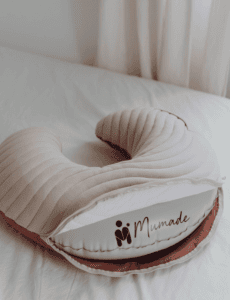
The Mumade nursing pillow isn’t just for breastfeeding — it’s perfect for bottle-feeding too.
It supports the arm, shoulder, and back, creating a cocoon of softness and connection.

A relaxed body produces more oxytocin, the very hormone that fuels love and trust. 🌸


Nourrir au biberon dans la physiologie : confort, rythme, eau, température.
Feeding by Bottle, Naturally and Mindfully
allaitement mumade

Mumade breastfeeding products

Discover our nursing pillows and accessories for easy breastfeeding

These articles may interest you

Et si vous sauvegardiez votre panier avant de partir ?

Enter your details below to save your shopping cart for later. And, who knows, maybe we will even send you a sweet discount code :)

mumade-van